
'/%3e%3cdefs%3e%3clinearGradient%20id='prefix__paint0_linear_4737_37157'%20x1='3.018'%20y1='23.6'%20x2='44.925'%20y2='24.977'%20gradientUnits='userSpaceOnUse'%3e%3cstop%20stop-color='%231CB7FF'/%3e%3cstop%20offset='.502'%20stop-color='%232FF58B'/%3e%3c/linearGradient%3e%3c/defs%3e%3c/svg%3e)


Beyond basketball, Jerry Lucas focuses on the power of memory
May 26 2026 19:08 · By Jolie Katzen, for NBA.com · 75 Reads


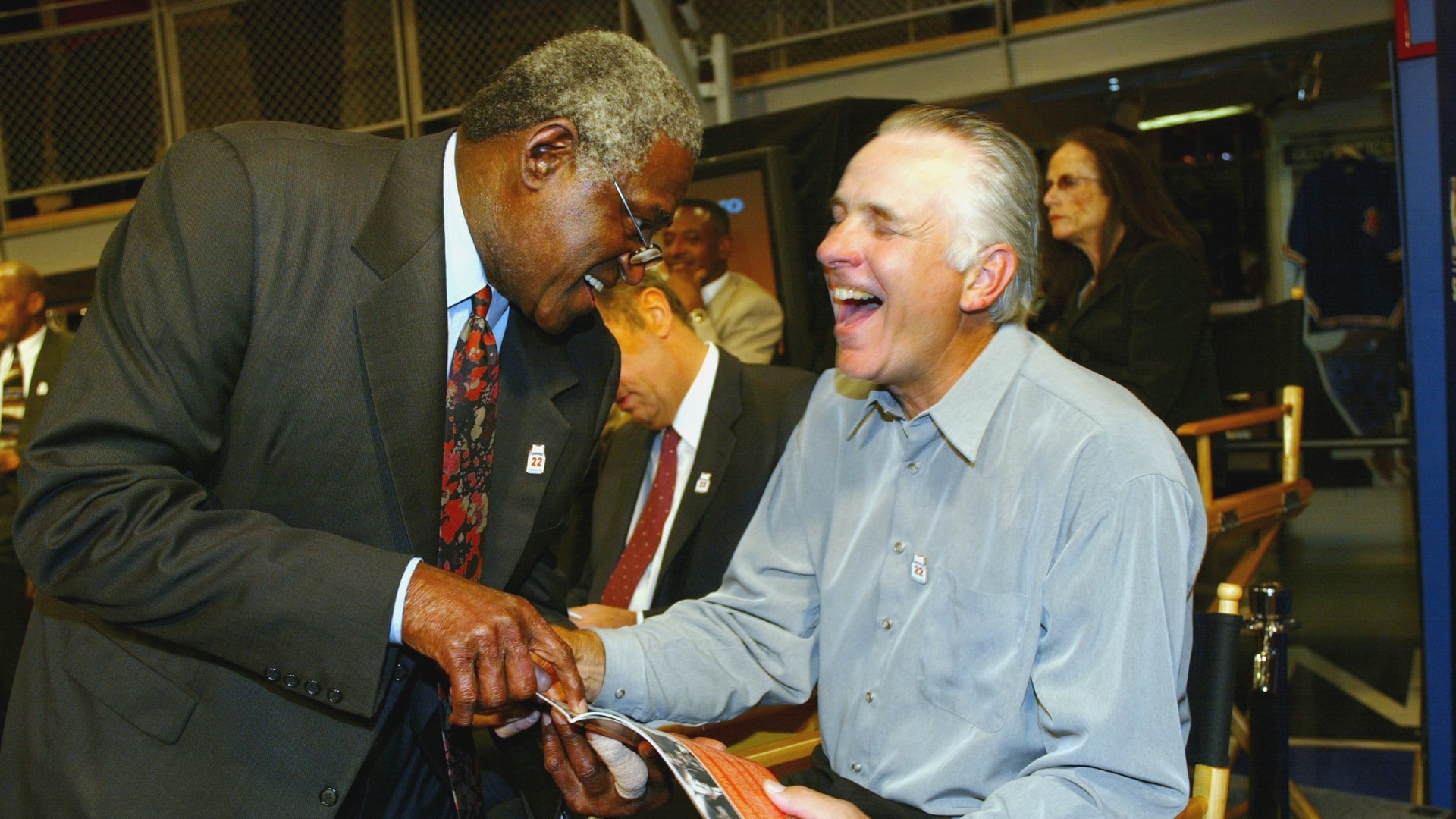
Willis Reed (left) and Jerry Lucas (right) share memories as the 1973 Knicks celebrate their 30th anniversary.
Long before he became an NBA champion, Jerry Lucas was counting paint stripes on highways.
Bricks on buildings. Pieces of glass in chandeliers. Highway markers. His mind was constantly organizing and processing information in ways that would later define both his basketball career and everything that followed it.
“As a boy, I had a very active mind,” Lucas said. “When I learned to count, I counted everything I saw.”
That same ability helped make him one of the most intelligent players the game has ever seen: a
Naismith Memorial Basketball Hall of Famer
, a 1960 Olympic gold medalist with Team USA, a seven-time All-Star and a key piece of the
New York Knicks’ 1973 championship team
.
Intelligence meets team basketball
Lucas was part of the 1960 U.S. Olympic team that many still consider the greatest amateur basketball team ever assembled, a roster featuring future Hall of Famers Oscar Robertson, Jerry West and Walt Bellamy that was later
inducted into the Basketball Hall of Fame
as a team.
At 6-foot-8, Lucas became one of the league’s premier rebounders, finishing his career averaging 15.6 rebounds per game, trailing only Wilt Chamberlain, Bill Russell and Bob Pettit. His impact wasn’t just physical … it was anticipatory.
“I started practicing missing shots, and I would watch where the ball went,” Lucas said. “I would also analyze and watch every time anybody shot. I would watch it, the arc on it, where it would go, and why. I got to the point where I had a computerized mechanism in my mind where I knew where the ball was going to go.”
After beginning his career with the Cincinnati Royals and later spending time with the San Francisco Warriors, Lucas was traded to the New York Knicks in 1971, joining what he still calls “a consummate NBA team.”
“It was an incredibly intelligent team,” Lucas said. “It was that kind of group where nobody was selfish, and we played the way we should. It was the most enjoyable time I had in my professional career.
That Knicks roster, featuring Walt “Clyde” Frazier, Earl Monroe, Willis Reed and Bill Bradley, defined an era built on discipline, balance and trust.
Lucas says he still keeps in touch with several of his former teammates, especially Monroe and Bradley.
“I enjoy talking with them, and having the opportunity to have some fond memories and some discussion about present times,” Lucas said.
From champion to “Dr. Memory”
Lucas’ resume already spans every level of the game: high school dominance in Ohio, an NCAA championship at Ohio State, Olympic gold in 1960 and an NBA title in 1973 — one of the few players to win at every stage.
But when he retired following the 1973-74 season, his next chapter would take him far from the box score.
These days, Lucas is known as “Dr. Memory,” a title tied to decades of books, seminars and demonstrations on memory training and recall systems. He co-authored “The Memory Book” with Harry Lorayne, which became one of the best-selling books in its field and helped introduce his methods to a wider audience.
That work eventually expanded into literacy systems designed to help children learn to read by making language more visual and easier to understand, rather than something they simply have to memorize.
“What children are called upon to learn in school is abstract and intangible letters, numbers, words and symbols that have no identity. We have a gift that allows us to store items in our mind and never forget them … once you see it, you can’t forget it. “I realized that I had an opportunity to change education and hopefully, it will make a tremendous difference in how children learn to read and write,” Lucas said.
Alongside that work, he recently finished a new book called Memorable Meetings.
“It’s about interesting or very funny stories from famous people I’ve met in my lifetime,” Lucas said. “Like Mickey Mantle, Yogi Berra, George Steinbrenner and Bobby Fischer.”
Reflecting on the Knicks’ present
Even today, Lucas remains connected to the sport that defined his first chapter. While focused on his writing and educational work, he is still following the NBA playoffs closely, and, as always, keeping an eye on the Knicks.
Watching this year’s team, he sees similarities to the championship group he played on more than five decades ago.
“You got a great guard leader in Brunson, and we had guard leaders like Frazier as well as Monroe,” Lucas said. “Willis Reed was our center, and, of course, Towns is doing a great job and playing the type of game I love to see played. I think many teams are similar through the ages and through the years, so there are definitely some similarities between the two teams.”
Lucas’ career has already secured its place in basketball history. But the work that continues to drive him today has much more meaning.
“What would be meaningful to me,” Lucas said, “is what it would mean to others. For them to be able to read, prosper and do things they never would’ve been able to do.”